
Os dados técnicos e as notas de medição são mantidos em inglês para evitar divergências entre traduções.
Perry Three.js
Your three.js app, compiled ahead of time to a native binary. Stock three from npm, your own HTML and CSS, real GPU APIs underneath. No JavaScript engine, no WebView.
Research preview · macOS · Windows · Linux · iOS · iPadOS · tvOS · Android
Shipping today
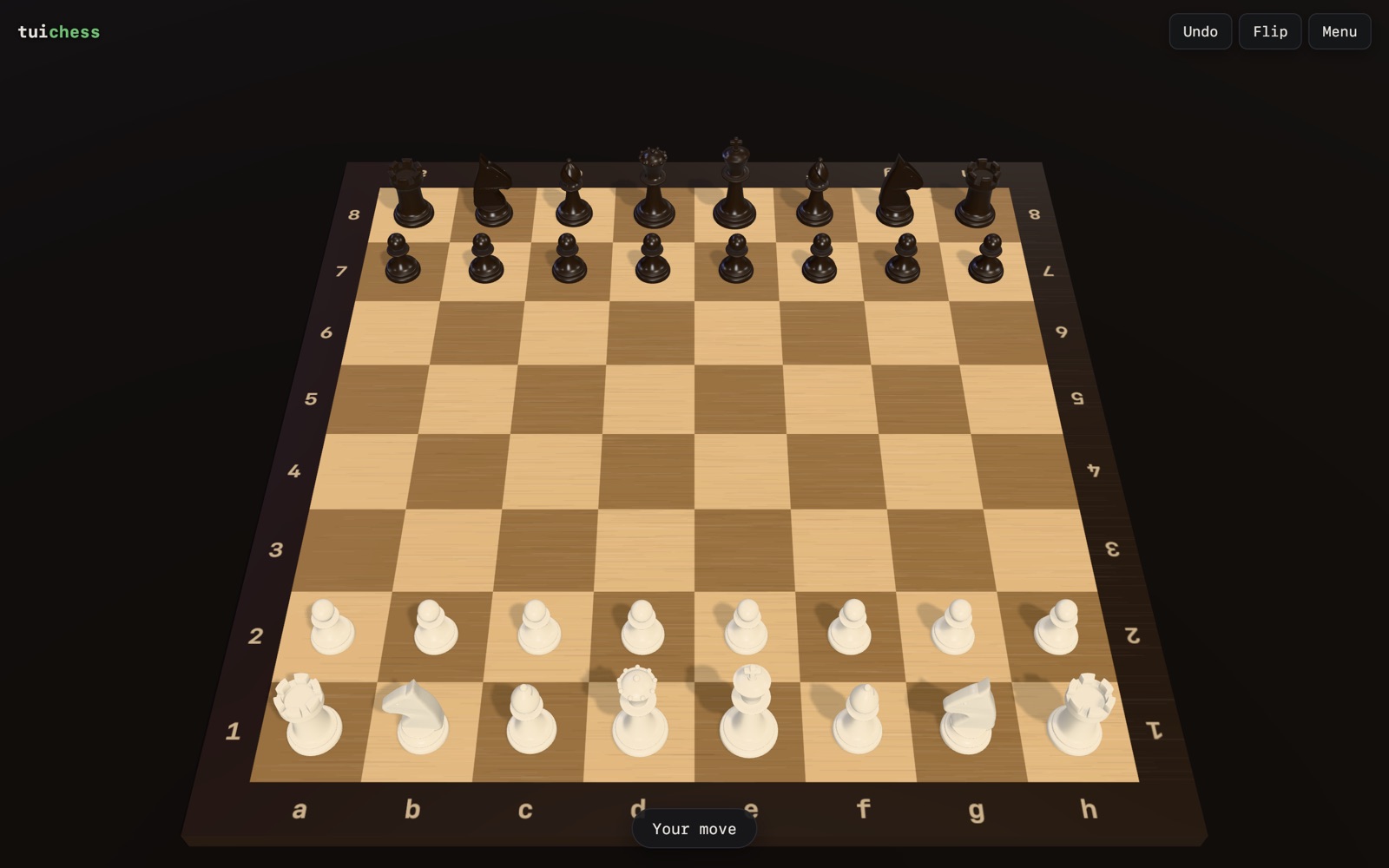
Play tuichess, a three.js chess game built with Perry
The chess game above is open source and on the App Store for iPhone, iPad and Mac. The store build uses Perry with the Bloom engine's three.js layer, which mirrors the three.js scene into Bloom's native renderer. The fully compiled three.js runtime described on this page is the research preview and is not in the store build yet.
How it works
Perry compiles TypeScript and JavaScript ahead of time through LLVM into a native binary. A three.js app needs more than a language, though: it expects a browser. Perry's web runtime provides those browser APIs natively inside the compiled program: DOM, CSS layout, canvas 2D, input, audio, fetch, storage, Workers, WebGL2 and WebGPU.
So three.js does not know it has left the browser. It calls gl.drawElements and the call goes to ANGLE, then on to Metal or OpenGL ES. It touches document and gets a native DOM. Your menus are real HTML and CSS, laid out and painted natively and composited over the 3D canvas.
- Unmodified
Stock three.js from npm
three 0.186.1 straight from npm, plus your app's own index.html and src/. Nothing in three.js or your app is patched, forked or aliased.
- WebGL2
ANGLE, the layer Chrome uses
WebGL2 calls go to Google's ANGLE, which runs on Metal on Apple platforms and on OpenGL ES on Android (Vulkan optional).
- WebGPU
wgpu underneath
three.js WebGPURenderer runs on wgpu, the WebGPU implementation used by Firefox and Deno.
- HTML + CSS
Your menus and HUD, drawn natively
The page around the canvas, such as menus, overlays and HUD, is laid out and drawn natively, then composited with the 3D scene.
What you write
The native entry point is a handful of imports. Everything after the last line is your existing web app, compiled as it is:
// main.ts: the whole native entry point
import "./config.ts";
import "@perryts/web";        // DOM, CSS, canvas, input, audio, fetch…
import "@perryts/web/webgl";  // WebGL2 on ANGLE
import "./src/main.ts";       // your unchanged three.js app
$ perry compile main.ts -o chess
$ ./chess
The same app builds for Windows, Linux, iOS, iPadOS, tvOS and Android with Perry's platform build scripts. The app'spackage.json opts in to the two native libraries it uses and nothing else.
Runs today on
Tested on Apple silicon Macs, iPad, Apple TV, Pixel 4a, iPhone 11 (iOS 18.6) and Galaxy S24.
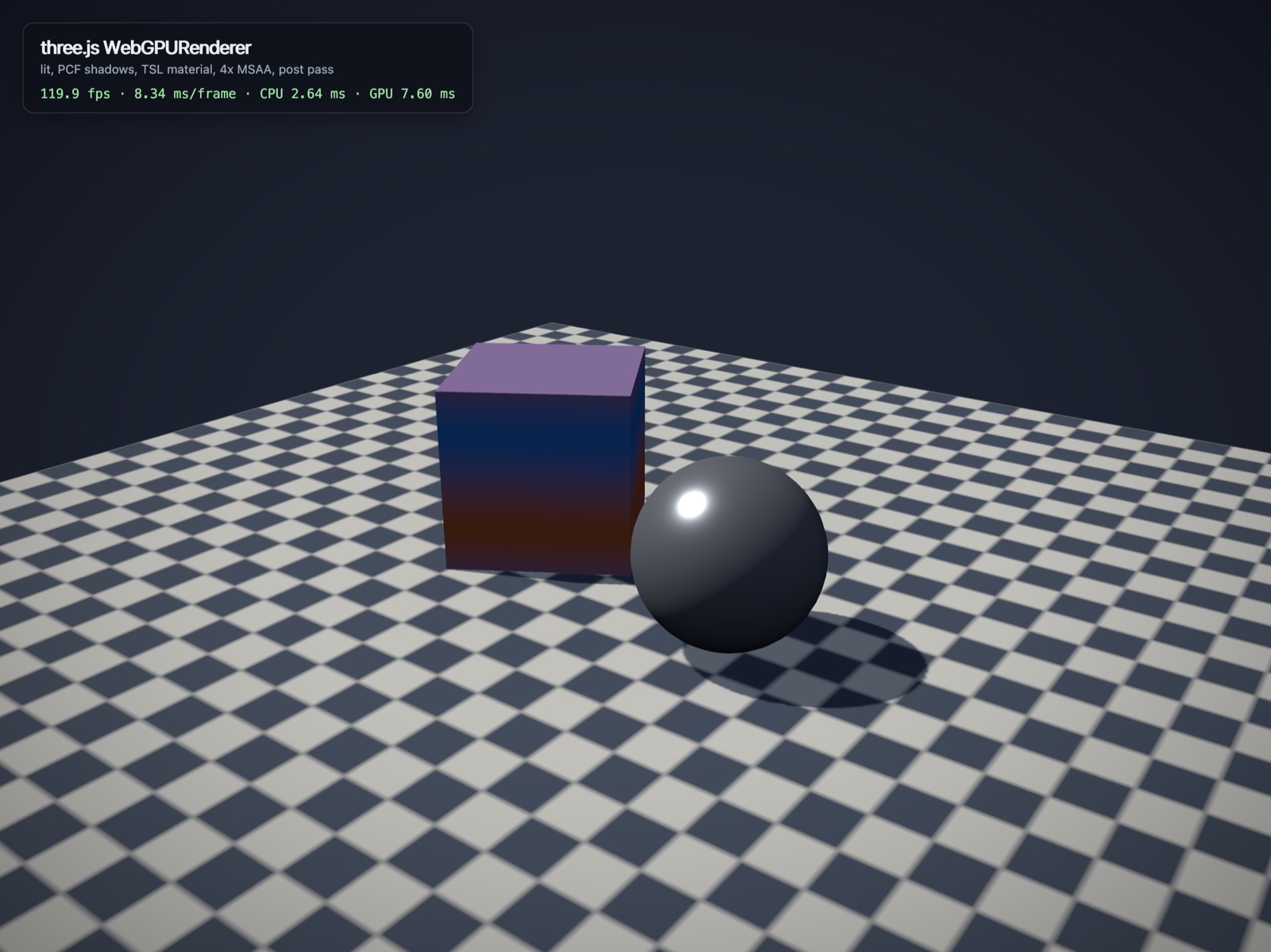
Measured against the standards
We hold the runtime to the same conformance suites browsers use, not to a hand-picked demo:
- 472 / 514Khronos WebGL conformance pages (Chrome: 513)
- 25,529WebGPU CTS tests passing (Chrome: 32,698)
What works
Exercised end to end by the demo apps:
- WebGLRenderer and WebGPURenderer
- GLTFLoader, skinned meshes, AnimationMixer
- Shadow maps and standard (PBR) materials
- OrbitControls, raycasting, CanvasTexture
- DOM, CSS, canvas 2D, input, audio, fetch, storage, Workers
Where it stands
Perry Three.js is a research preview. Rendering is correct and runs on real devices, but performance is not yet where it needs to be: script-heavy three.js scenes currently run several times more instructions than in V8. The cause is understood. Compiled in isolation, Perry beats V8 on three.js math:Matrix4.multiplyMatrices takes 237 instructions against Node's 417. Inside a full app, the same function takes about 6,000, roughly 14× slower than Node, and that is what users get today. The gap exists because the compiler loses the whole-program type proofs it needs once the whole app is in play. Closing that gap is the job of Solver, which uses this chess app as its test ladder.
Known gaps:
- CSS backdrop-filter and color emoji are not implemented yet.
- Post-processing and the official three.js examples suite have not been tested yet.
- No npm packaging yet: builds run from Perry's in-house web runtime for now.
Want your three.js app native?
We're looking for real three.js apps to bring up next. Tell us what you're building.