Los datos técnicos y las notas de medición se mantienen en inglés para evitar divergencias entre traducciones.
Compila TypeScript a nativo.
One Codebase, Many Targets.
Perry compiles TypeScript to native GUI and CLI apps for macOS, iOS, iPadOS, visionOS, tvOS, watchOS, Android, Wear OS, Windows, Linux, and Web/WebAssembly, with a separate HarmonyOS preview. Native binaries statically link the Perry runtime and GC; they do not require Node.js or an external JavaScript engine.
$ perry compile main.ts
Compilando main.ts...
✓ Example executable written: main (size varies by linked features)
$ ./main
Hello, World!
Apps reales, compiladas desde TypeScript con Perry.
¿Por qué Perry?
The current compiler, runtime, UI, and tooling surfaces — with limitations called out
No External JS Engine
Native builds run without Node.js, Bun, Deno, or an external JavaScript engine installed. The Perry runtime and garbage collector are statically linked into each target-specific binary.
Compilación rápida
Compilación directa de TypeScript a código nativo usando SWC para el análisis y LLVM para la generación de código optimizado. Sin JavaScript intermedio.
Size Scales With Features
Hello world can be about 330 KB and Mango is published at about 7 MB. Applications that link the full standard library can be much larger; size depends on target, imports, and build profile.
Cacheable Builds
Perry caches module objects and can pin a CPU baseline for portable output. Default host builds tune for the local CPU, and final binaries may contain platform UUIDs, timestamps, or signatures, so byte-for-byte cross-machine reproducibility is not promised.
Tracked Node.js APIs
Native implementations cover many familiar Node.js APIs across 53 tracked modules. Coverage is broad but not complete; use perry check and the published limitations for your project.
Paquetes npm reales
npm packages are compiled natively alongside your code — there is no embedded JavaScript engine. Packages that depend on native addons or not-yet-supported dynamic semantics may not work yet.
35+ Native UI Widgets
35+ native UI widgets map to platform toolkits including AppKit, UIKit, GTK4, Win32, Android SDK APIs, SwiftUI on watches, and a DOM/CSS bridge on Web/WASM. Availability varies by target.
Compile-Time Plugin System
Modules can compose at build time and statically linked dependencies can become direct native calls. Dynamic dispatch and runtime support remain where JavaScript semantics require them.
True Multi-Threading
Real OS threads with parallelMap, parallelFilter, and spawn. Mutable captures are rejected by default; SharedArrayBuffer and Atomics provide explicit shared-memory coordination, with documented typed-view caveats.
Compile-Time i18n
Automatic string extraction, CLDR plural rules for 30+ locales, and compile-time validation. Translations are baked into the binary; lookup cost depends on the generated catalog and call site.
Profundiza: cómo Perry compila TypeScript a un binario, qué lo convierte en un compilador nativo de TypeScript, y cómo se compara frente a alternativas a Electron.
Mira lo que la gente construye
Public native applications compiled from TypeScript, with platforms and capabilities taken from their current project pages.

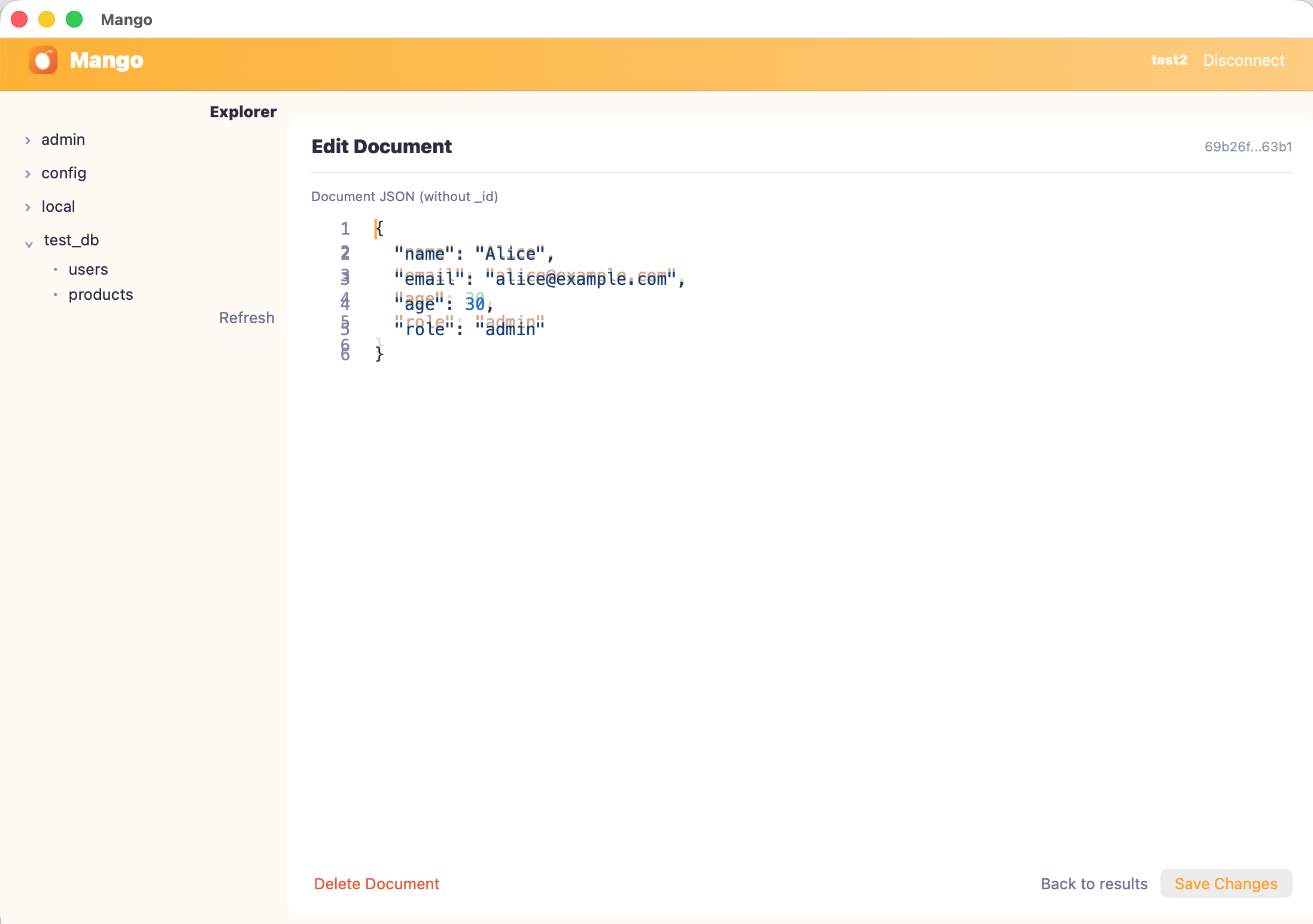
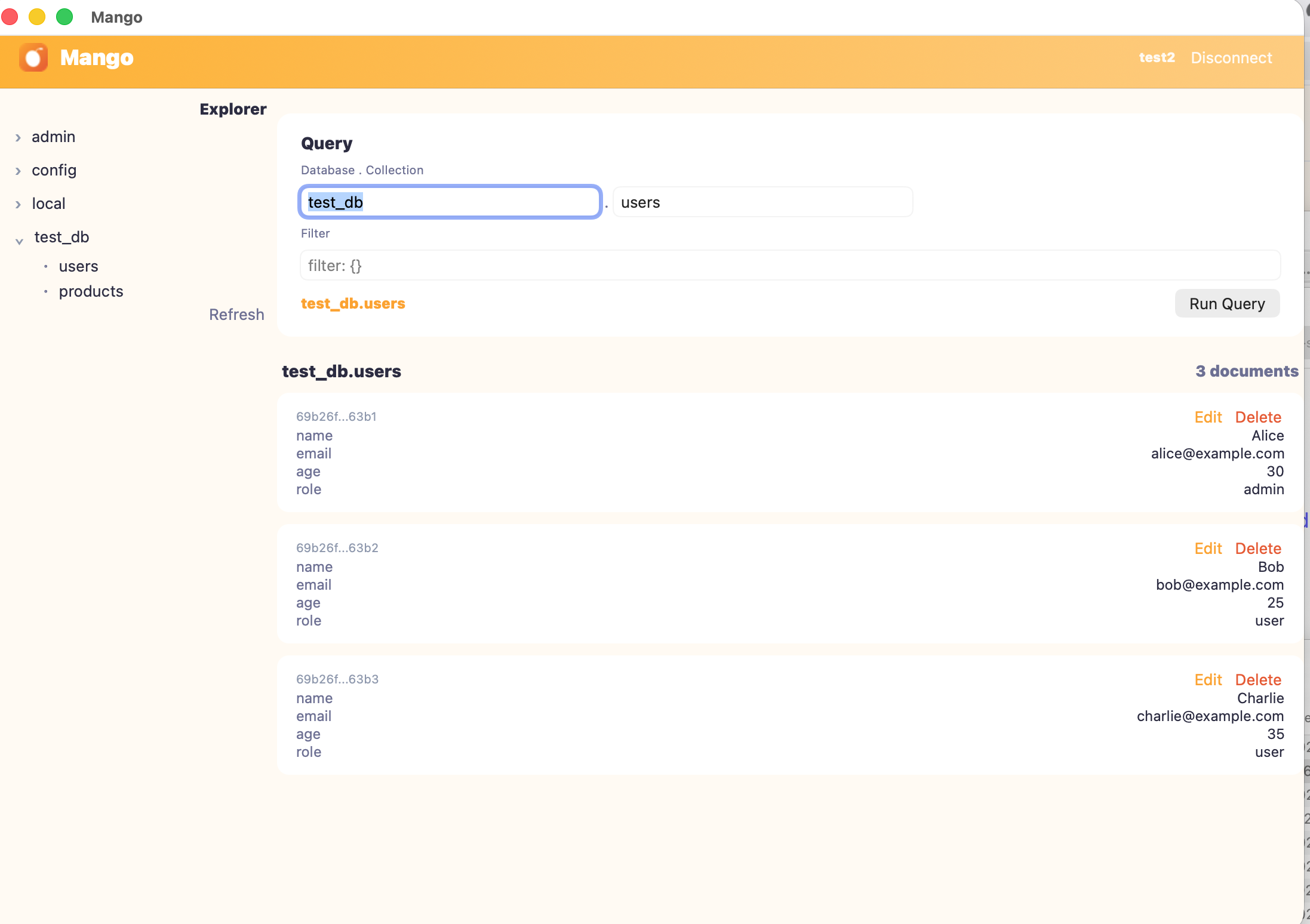
Mango
GUI nativa para MongoDB — construida completamente en TypeScript

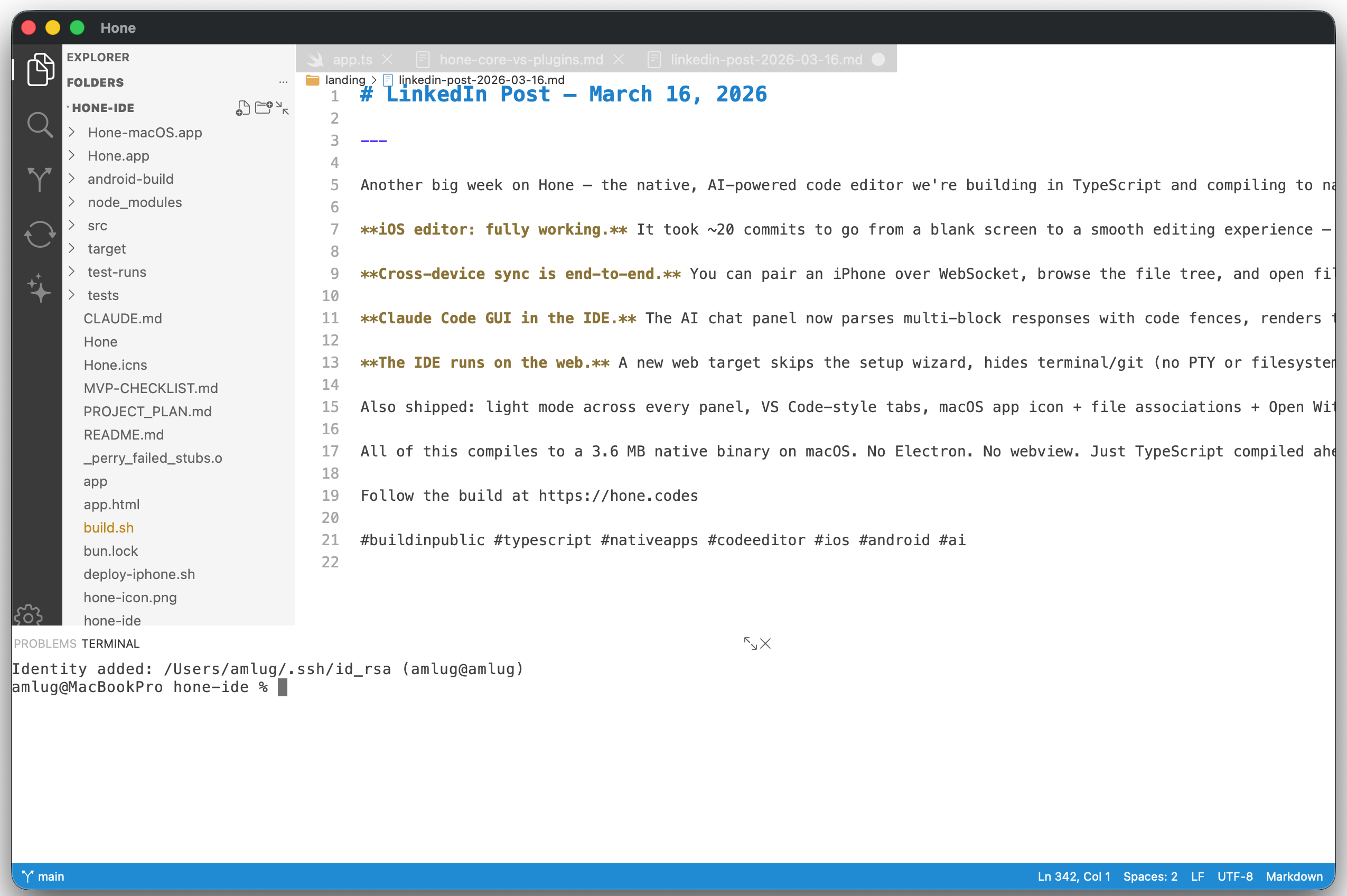
Hone
Editor de código nativo con IA — TypeScript a binario nativo
Native across documented targets
Eleven documented targets share Perry’s compiler and UI model. Web and WASM are aliases; visionOS, watchOS, and Wear OS have narrower core support, and HarmonyOS is a separate preview.
macOS
AppKit
iOS
UIKit
iPadOS
UIKit
visionOS
UIKit (2D)
tvOS
UIKit
watchOS
SwiftUI
Android
Android SDK
Wear OS
Android SDK
Windows
Win32
Linux
GTK4
Web / WASM
DOM/CSS bridge
--target web and --target wasm are aliases
HarmonyOS
ArkUI
Separate preview; not included in the 11 documented targets
11 documented targets; HarmonyOS is listed separately as a preview. See the platform status guide
Del código al App Store
The perry publish command supports build, signing, packaging, verification, and submission workflows. Availability and prerequisites vary by platform and hosted-service configuration.
Build & Sign
Create platform artifacts and use configured signing credentials. Apple, Android, and Windows workflows require their platform SDKs, accounts, and certificates.
Distribute
Prepare store submissions or direct-download artifacts for supported targets. Store acceptance and processing remain controlled by each store.
Verify
Run available launch and UI checks through Perry and Geisterhand. Test depth and target coverage depend on the selected environment.
Local compilation is free and MIT licensed. Check hosted-service availability → /publish
Perry’s native compilation model
Ahead-of-time machine code and real platform widgets, with an explicitly linked runtime and documented compatibility tradeoffs.
Designed for
- ✓Ahead-of-time machine code through LLVM
- ✓Real platform widgets where each target supports them
- ✓No external Node.js installation or JavaScript engine
Tradeoffs to evaluate
- –The Perry runtime and GC are statically linked; overhead is not “none”
- –Perry implements a practical TypeScript and Node.js subset; some packages are not supported yet
- –Platform capabilities and maturity differ across desktop, mobile, wearable, TV, and Web/WASM targets
Competitor-specific pages are dated and link to upstream documentation. View sourced comparisons
Escribe TypeScript, envía nativo
Use familiar TypeScript syntax and validate each API or package against Perry’s current compatibility surface.
// hello.tsconst greeting = "Hello, World!";console.log(greeting); // Output size varies with target and linked features// No external JavaScript runtime installation needed!Published measurements
Current public results include wins, mixed results, and losses. Treat microbenchmarks as workload-specific measurements, not a universal speed claim.
| Métrica | Perry | Node.js | Bun |
|---|---|---|---|
| Tamaño del binario | ~330 KB hello world; ~7 MB Mango | Application plus an installed Node.js runtime | Standalone executable embeds the Bun runtime |
| Tiempo de inicio | ~3.2 ms* | Engine boot and warmup; workload-dependent | Engine boot and warmup; workload-dependent |
| Dependencias de runtime | Statically linked Perry runtime + GC | External Node.js runtime | Embedded Bun / JavaScriptCore runtime |
| Overhead de memoria | Workload-dependent | Workload-dependent | Workload-dependent |
* Measured runtime-only macOS hello world on an Apple M-series host (5.0 → 3.2 ms after removing unused dynamic-library links). Application startup varies.
Full public suite: wins and losses
Perry 0.5.1355 · Node.js 22.23.1 · Bun 1.3.14 · Apple M1, 8 GB · 2026-08-08
Lower wall-clock median is better. Five complete process samples; correctness checks passed. Benchmark names and descriptions remain English technical identifiers.
| Benchmark | Perry | Node.js | Bun | Result |
|---|---|---|---|---|
factorial Modular accumulation | 94 ms | 95 ms | 95 ms | Win vs both |
method calls Class method dispatch | 9 ms | 10 ms | 8 ms | Mixed |
closure Closure creation and invocation | 47 ms | 49 ms | 49 ms | Win vs both |
binary trees Tree allocation and traversal | 4 ms | 6 ms | 6 ms | Win vs both |
string concat String append loop | 2 ms | 4 ms | 1 ms | Mixed |
prime sieve Sieve of Eratosthenes | 28 ms | 6 ms | 5 ms | Loss vs both |
mandelbrot Complex-number iteration | 22 ms | 24 ms | 28 ms | Win vs both |
matrix multiply Matrix multiplication | 85 ms | 33 ms | 33 ms | Loss vs both |
JSON roundtrip Parse and stringify ~1 MB JSON | 184 ms | 380 ms | 220 ms | Win vs both |
Comenzar
Instala Perry y empieza a compilar TypeScript a ejecutables nativos
1Instalación
$ npm install -g @perryts/perryRecommended cross-platform install. Native targets still require the relevant platform SDK and linker; run perry doctor after installation.
2Uso
perry doctorChecks the compiler, linker, SDK, and target setup
perry compile main.tsCompila main.ts a un ejecutable nativo
perry compile main.ts -o myappEspecificar el nombre del ejecutable de salida
perry check ./srcValidar código TypeScript para compilación nativa
Soporte de características
Tested surfaces and known partial areas — not a blanket claim of complete TypeScript or Node.js compatibility
Lenguaje base
- ✓Numbers (f64 + selected unboxed representations)
- ✓Strings (UTF-8)
- ✓Booleans
- ✓Arrays
- ✓Objects
- ✓BigInt (fixed 1024-bit)
- –Proxy
- –eval / runtime-generated code
Funciones
- ✓Function declarations
- ✓Arrow functions
- ✓Default parameters
- ✓Rest parameters
- ✓Closures
- ✓Higher-order functions
- ✓Async / await
- –Runtime-computed dynamic import
Clases
- ✓Classes and constructors
- ✓Private fields (#)
- ✓Static methods / fields
- ✓Getters / setters
- ✓Inheritance and super
- –Decorators and reflection
- –Dynamic prototype manipulation
- –Weak references / finalizers
Sistema de tipos
- ✓Type annotations
- ✓Local type inference
- ✓Generics / specialization
- ✓Interfaces
- ✓Union types and guards
- –Runtime type validation
Biblioteca estándar
- –fs / path / os
- –crypto
- –Buffer and streams
- –http / http2 / net / tls
- –child_process / worker_threads
- –WebAssembly global
- –~97% Node suite · 53 modules
“Partial” means the API or syntax exists with documented gaps. Exact behavior changes as parity work lands. Read the current limitations
~50 Native Packages and Node APIs
Many popular packages and Node APIs have native implementations. Coverage is package- and feature-specific; perry check and the compatibility documentation are the source of truth.
Base de datos
Seguridad
HTTP
Procesamiento de datos
Fecha y hora
Utilidades
Cómo funciona
From TypeScript source through SWC, Perry HIR, LLVM, and the linked runtime
¿Quieres saber cómo funciona el compilador internamente? Internos del compilador
Análisis a fondo: TypeScript sobre LLVM — monomorfización, NaN-boxing y por qué Perry abandonó Cranelift.
Un lugar donde el código de Perry puede descansar y ejecutarse.
Coop convierte un directorio de TypeScript compatible con Perry en una biblioteca de aplicación nativa y la sirve por HTTP, mientras el runtime y la biblioteca estándar de Perry se proporcionan una sola vez por máquina.
- ✓Proveedores de runtime compartidos
- ✓Un worker por despliegue
- ✓Desplegar, inspeccionar y revertir
Preguntas frecuentes
Todo lo que la gente pregunta antes de compilar su primer binario
¿Perry necesita Node.js o un runtime?
Native Perry binaries run without Node.js, Bun, Deno, or an external JavaScript engine installed. They do include the Perry runtime and garbage collector, statically linked. npm packages are compiled natively too; no JavaScript engine is embedded.
¿Qué tamaño tienen los binarios compilados?
Size depends on the target, imports, and build profile. The published examples range from about 330 KB for hello world to about 7 MB for Mango; full-standard-library builds can be much larger. Treat any size as a measured example, not a universal output size.
¿Puedo usar paquetes npm?
Many pure TypeScript/JavaScript packages compile natively, and roughly 50 package/API implementations are tracked. Compatibility is not universal: packages using native addons or not-yet-supported dynamic behavior may not work yet. Run perry check and consult the limitations.
¿Qué plataformas soporta Perry?
Perry documents 11 targets: macOS, iOS, iPadOS, visionOS, tvOS, watchOS, Android, Wear OS, Windows, Linux, and Web/WASM. Web and WASM are aliases; HarmonyOS is a separate preview. Platform maturity and API coverage differ, so consult the platform guide.
¿Perry es gratis y de código abierto?
The compiler and runtime repository is MIT licensed, and local compilation requires no account. Hosted Perry Publish and commercial support are separate services; availability, limits, and pricing are confirmed in the service or in writing.
¿En qué se diferencia Perry de Bun o de deno compile?
Bun and Deno standalone executables bundle their runtimes; Perry native builds compile through LLVM and do not embed a JavaScript engine, although they statically link the Perry runtime and GC. Exact size and startup comparisons are version-, platform-, and workload-specific. See the dated Perry vs Bun and Perry vs Deno pages.
¿En qué se diferencia Perry de Electron o de Tauri?
Electron ships Chromium and Node.js; Tauri uses a system webview with native-side application code. Perry instead maps its UI model to platform widgets where supported. Bundle size and platform capability vary, so use the dated Perry vs Electron and Perry vs Tauri comparisons rather than a universal size claim.
¿Qué tan maduro es Perry?
Perry is pre-1.0 and changes quickly. Real projects use it today, but language, package, and platform parity are still active work. Review the showcase, current limitations, and changelog before committing a production workload.
¿Más preguntas? Lee la guía para comenzar o pregunta en GitHub Discussions.